What exactly does Techleap do, and what is your role within the organisation?
Techleap’s primary focus is the Dutch tech sector, particularly start-ups and scale-ups. We do this by working with government and other stakeholders to improve policy, collecting data and addressing bottlenecks — as well as by working directly with entrepreneurs who are on the verge of scaling their businesses. Our organisation has reinvented itself several times over the years. Today, we have a public arm focused on deep tech and the wider ecosystem, funded by the Ministry of Economic Affairs and Climate Policy, as well as a community of around 500 privately funded companies. We have also recently established an AI hub and co-working space. As Managing Director, I try to maintain a clear overview of the entire playing field while keeping our eyes on the ball, so that we continue to maximise our impact.
How is the Netherlands performing when it comes to digital competitiveness?
I think the distinction between “digital” and “competitiveness” has become somewhat artificial by now — the two can no longer really be seen separately. I still consider our physical and mobile network infrastructure to be strong, also compared with other European countries. However, I do see that we have stagnated when it comes to data centres, while other countries are accelerating — mainly because of limited access to electricity. We are producing interesting tech companies, but we are not at the critical end of AI software and large language models. On the hardware side, however, with companies such as ASML, BESI, ASMi and players such as Nearfield Industries, we are in a strong position.
What level of ambition is needed to keep the Netherlands internationally competitive in the years ahead?
I certainly see that ambition — and I share it. But I believe our government could act with greater decisiveness and focus in this area. Make it a clear national priority, develop policies around it and implement them consistently. The tech sector is increasingly becoming the engine of our economy and will ultimately produce the innovations we need for healthcare, defence and social security in the future. If you look at things purely through today’s political lens, you see that choices — such as those surrounding the Box 3 tax debate — are not being made from the perspective of structural growth or the attractiveness of the Netherlands as a place to do business, but from the perspective of the 2026 budget. I think we risk driving away capital and talent as a result, even though fundamentally this is not really a budgetary problem.
What role does digital infrastructure play in this?
For me, this is the baseline — the foundation of the economy of the future. Connectivity, digital infrastructure and security are basic prerequisites, just like the rule of law or a stable democracy.
What is currently working well in the Netherlands’ digital infrastructure?
Our physical and mobile networks are actually among the most advanced in Europe. We have traditionally had strong internet infrastructure and, on the hardware side, companies such as ASML, Nearfield Industries and Accelera AI. So the fundamentals are in good shape. I even think we had a very strong position with AMS-IX, but I see that position starting to erode somewhat. The entire data centre sector is under scrutiny because of its energy consumption, and it is difficult to translate the abstract argument that we need more computing power into what this actually means for people in the Netherlands — not today, but tomorrow.
Where do you see the most important areas for improvement?
For me, the key issue is the availability of electricity. Renewables are currently priced at the level of fossil fuels, whereas their potential is actually to provide almost free energy. We need to move from expensive, scarce energy to cheap, abundant energy. Just imagine what we could achieve with our economy in an energy-abundance scenario. And it is possible. That is why we need to electrify demand — in industry, mobility and hydrogen — while continuing to invest in innovation around batteries, hydrogen, chips and data centre cooling. I also believe that critical infrastructure and source code should be independent and protected, regardless of who happens to own them today.
What impact is AI having on our digital infrastructure?
We are heavily dependent on American and Chinese models, with Mistral as a European alternative. As long as that diversity remains, we are reasonably resilient. But if both superpowers were to cut off access, we would have neither the models nor the computing capacity needed to run our own AI. We also do not have a sovereign European cloud — and we should.
What do you see as the biggest threats to the Netherlands’ ability to remain internationally competitive?
I see a lack of areas in which others depend on us — chokepoints, such as the position we have with ASML in the semiconductor supply chain, but in AI. As a result, we have very little leverage if the Americans put pressure on us. We are also vulnerable because of our dependence on China for raw materials, particularly battery cells and the basic materials needed for our energy and communications sectors.
And where do you see the biggest opportunities?
The Netherlands sometimes seems like an end-state society — we have essentially achieved everything we set out to achieve. But that does not remain the case automatically. That is precisely why we need to consciously create room for growth again: simplify regulations, be willing to take risks and accept that mistakes will happen. This requires a clear long-term vision that is implemented consistently, with business as a partner rather than an adversary. We also need to invest in people and skills. We need to remove barriers that make it difficult for entrepreneurs to grow, such as the obligation to continue paying an employee’s salary for two years in the event of illness. That burden is simply too heavy for start-ups and small businesses.
What bottlenecks need to be addressed to seize these opportunities? And what role should government play?
Start-ups should not be seen as a side issue within “entrepreneurship”, but as an integral part of industrial policy. I would like to see the government act as a demanding and consistent customer of scale-ups. At the moment, Techleap is the organisation that is constantly challenging the government. I would much rather see the government itself come forward with a clear demand and ask us to deliver.
If you could give one urgent piece of advice to a state secretary or European commissioner, what would it be?
My advice would be consistency — and, more specifically, three things: First, finance AI infrastructure as much as possible through private capital, while facilitating this through permits and regulation. Second, structurally address grid congestion and the shortage of electricity. Third, have government lead by example when it comes to digital ways of working and the use of AI.
What can we do to further strengthen the Dutch digital economy, and what kind of coalition is needed?
I think we first need to decide for ourselves what we want, and then take that position to Europe. At the moment, I do not think we are internally coherent: we advocate fiscal discipline while simultaneously wanting to invest more in defence and infrastructure; we receive a relatively large amount of European research funding while at the same time wanting to cut back on it. We risk remaining focused on the supply side, while China has primarily stimulated demand — through the electrification of industry and mobility — which means it is now growing faster than we are in renewables. A cheaper green energy base for our businesses would certainly be valuable, and would also make us less dependent.
About this series: How can the Netherlands remain digitally competitive in Europe and the world?
In the run-up to the Staying Ahead: Connectivity for Europe’s Next Decade symposium on 15 October 2026, VodafoneZiggo is gathering insights from leading figures in Dutch business, government and the technology sector. These insights will be brought together in a white paper, which will be presented during the event.
For more information about the symposium, please contact communicatie@vodafoneziggo.com.
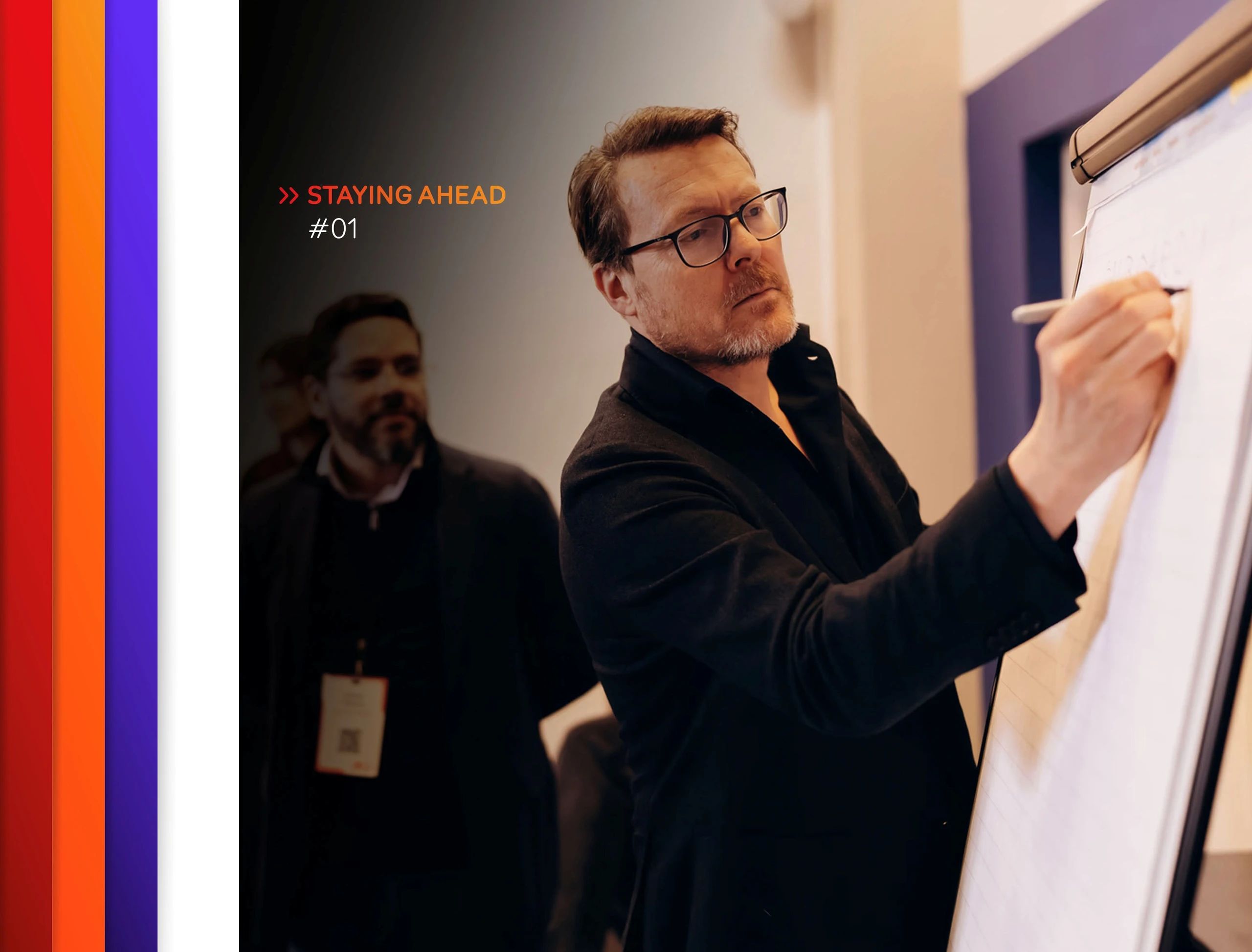
The Netherlands’ digital competitiveness is under pressure. AI, geopolitical developments and the country’s growing dependence on foreign technology require clear choices about the economy of tomorrow. To determine what is needed to remain at the forefront of digital innovation, VodafoneZiggo’s 'Staying Ahead' series brings together leading figures from Dutch business, government and the technology sector. In this first episode, Constantijn van Oranje, Managing Director of Techleap, shares his views on the role of technology, entrepreneurship and long-term policy.